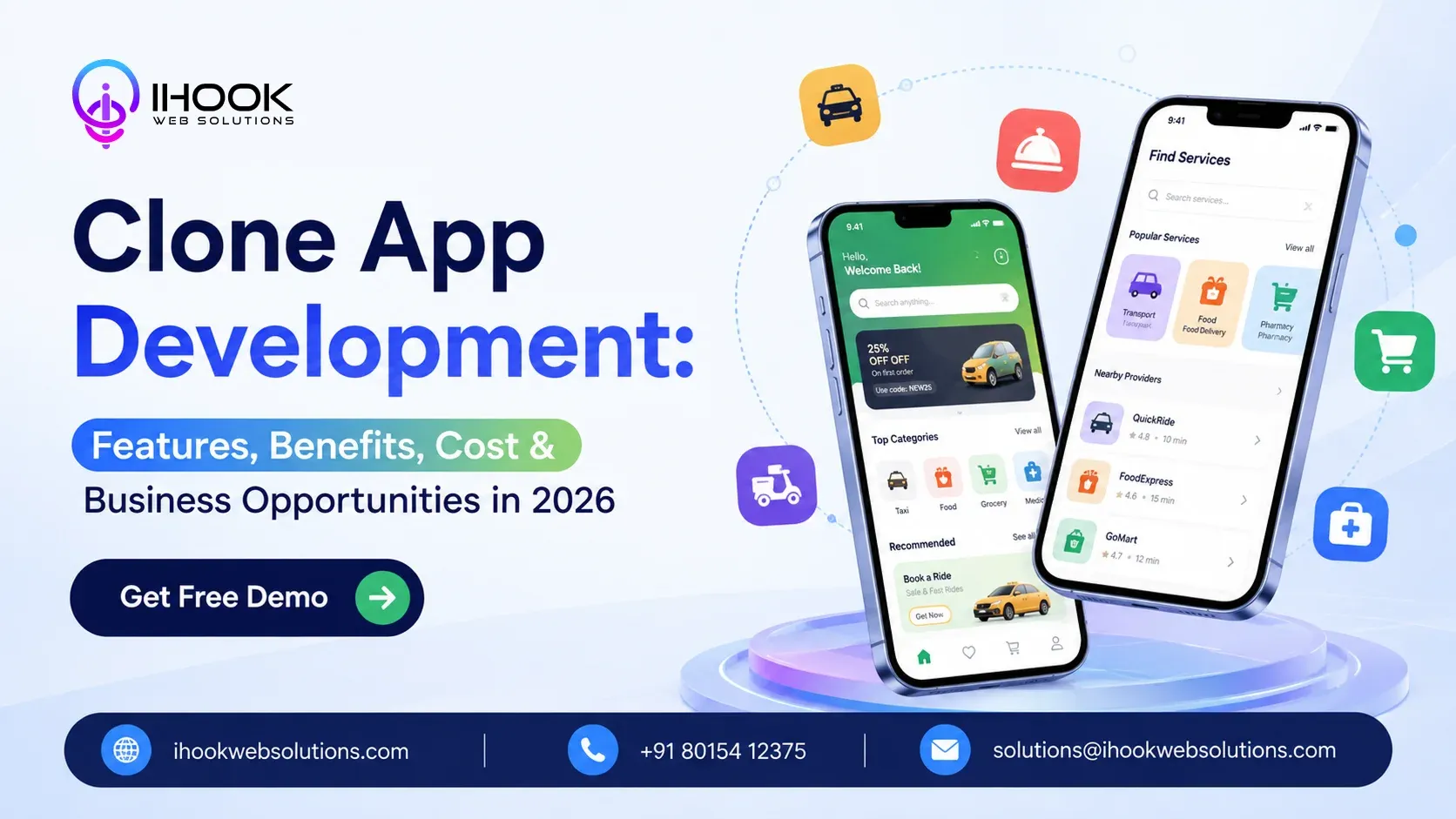
The mobile app market is a very competitive place, but that doesn’t mean companies always have to come up with an entirely new idea to get into it. Existing app models can be a good starting point for launching a new digital product, especially if the goal is to target a specific audience, location, or business niche. Here is the use of clone app development.
"A clone app is not just a copy of an existing app. It is a proprietary solution, built on a proven business model, allowing the business owner to bring their own unique brand, design, features, pricing strategy and customer experience. You can also customise the latest cloning solutions to meet your business operational needs."
What Is Clone App Development?
Clone app development is the process of creating a new app based on the existing app functionality and business workflow. Developers implement the required functionality with their own source code instead of copying proprietary source code.
For instance, an entrepreneur might create a social networking site based on popular social apps but build an entirely different brand, interface, user community, and business model.
The key difference is between copying a business idea and copying intellectual property from one company to another. A professionally developed solution should feature original code, branding, visual identity and customised functionality.
Why Businesses Consider Clone Apps in 2026
The one benefit is that you are not creating something from the ground up but have a tested business plan. Companies can target improving the experience for a particular group.
There is also the development efficiency benefit. There are frameworks and workflows to be reused that can decrease the level of base development. However, the requirements for the number of platforms, integrations, customisation, backend architecture, security requirements, and real-time functionality vary significantly and will greatly affect the actual budget and time required. As of now, industry estimates are that app projects could range anywhere from a relatively simple MVP to a much more complex marketplace platform, which will cost quite a bit more.
Essential Features of a Modern Clone App
A successful clone solution should go beyond simply reproducing basic screens. Important features may include:
- Secure registration and login
- User profiles and account management
- Search and filtering
- Push notifications
- Real-time communication
- Payment gateway integration
- Location and GPS functionality where required
- Ratings and reviews
- Admin dashboard
- Analytics and reporting
- Cloud-based backend infrastructure
- Data protection and security controls
- Scalable architecture for increasing users
The exact feature set should be selected according to the business model rather than adding every possible function from the beginning.
Popular Clone App Opportunities
Different industries provide different opportunities for entrepreneurs. Some popular examples include:
Instagram Clone App
Imagine Instagram, but with profiles and sharing of images and videos, stories, followers, comments, reactions, messaging, and content discovery. Instead of trying to compete globally, a business could develop a niche social platform for a specific community or interest.
Facebook Clone App
A social media platform like Facebook will be able to feature profiles, posts, groups, pages, messaging, notifications, media sharing and community interactions. Specialized opportunities can be developed by local communities, professional organizations, education systems and private groups.
WhatsApp Clone App
A WhatsApp-like communication app can facilitate private messaging, group messaging, voice calls, video calls, file sharing, media sharing, and notifications. Businesses can also create a communication platform around a specific community or organisation.
Spotify Clone App
A Spotify-style streaming platform can provide music or audio discovery, playlists, subscriptions, search, recommendations, and personalized libraries. The business model can be adapted for independent artists, regional content, podcasts, or specialized audio services.
Taxi Clone App
Taxi platforms connect passengers with drivers through booking, GPS tracking, fare calculation, driver management, digital payments, and trip history. Businesses can customize the model for local transportation services, corporate travel, or specialized mobility services.
Food Delivery Clone App
A food delivery platform generally requires customer, restaurant, delivery partner, and administrator workflows. Features such as menus, cart management, order tracking, online payments, restaurant management, and delivery assignment form the core of the system. Multi-sided delivery applications can require significantly more backend work than a basic mobile app.
Laundry Delivery Clone App
A laundry delivery platform can connect customers with laundry service providers and delivery partners. Useful features include pickup scheduling, service selection, order tracking, pricing, payment processing, and status notifications.
Turf Booking Clone App
A turf booking platform can help customers discover sports facilities, check availability, reserve time slots, make payments, and manage bookings. Turf owners can use an administration panel to control schedules, pricing, facilities, and reservations.
Benefits of Clone App Development
The most obvious benefit is that it results in faster time-to-market. Companies have the advantage of beginning with a proven workflow and investing more time in developing their USP.
A validation of the business model is another advantage. Entrepreneurs can save themselves the trouble of spending large sums of money on something untested by releasing an incomplete version, gaining user feedback, and expanding upon it.
Making clones can be a good way of saving money, particularly when one considers the reuse of existing customizable components, instead of making every core feature from scratch. Customization can drive up costs, so companies should figure out their key requirements before development begins.
How Much Does Clone App Development Cost in 2026?
There is no fixed price for a clone application. A basic application with limited functionality requires less development effort, while a multi-sided marketplace with real-time tracking, payment integration, multiple applications, and advanced administration features requires significantly more planning and development work.
The final cost depends on:
- Number of platforms
- UI/UX requirements
- Feature complexity
- Backend architecture
- Third-party API integrations
- Payment systems
- Real-time functionality
- Security requirements
- Admin and vendor modules
- Testing and maintenance
Business Opportunities in 2026
An opportunity that may not seem obvious is not the creation of a direct competitor for any application on a global scale but rather adapting an already proven concept to a niche area.
A company could choose to cater to a certain city, a language, a professional field, a certain industry, a particular customer base, or even some kind of specialty service.
Should companies be looking to design a new application for their business, IHook Web Solutions will gladly help translate a proven concept of an app into a custom solution for your business needs.
Final Thoughts
The cloning of apps provides a practical way of entering into an already developed digital market without having to develop everything from scratch. The true merit of cloning comes with the process of customization which requires an understanding of the target audience, knowing the shortcomings of the current apps, and then creating a better experience for users.
In 2026, the smart move will not be to clone an existing app. Rather, it will be to understand what is being offered, determine user needs, and produce a branded product.
Frequently Asked Questions
1. What is the average cost of clone app development?
Clone app development costs vary based on the app type, features, platforms, customization, integrations, and technical complexity.
2. What factors influence clone app development costs?
Features, UI/UX design, backend development, third-party integrations, security, platform selection, and maintenance can affect the overall cost.
3. Is clone app development more affordable than building from scratch?
It can be more cost-effective because proven workflows and reusable components can reduce the initial development effort.
4. Does customization increase the cost of a clone app?
Yes, adding unique features, custom designs, advanced integrations, and specialized functionality can increase development costs.
5. How can I reduce clone app development costs?
Start with essential features, launch an MVP, select the required platforms, and add advanced functionality as the business grows.