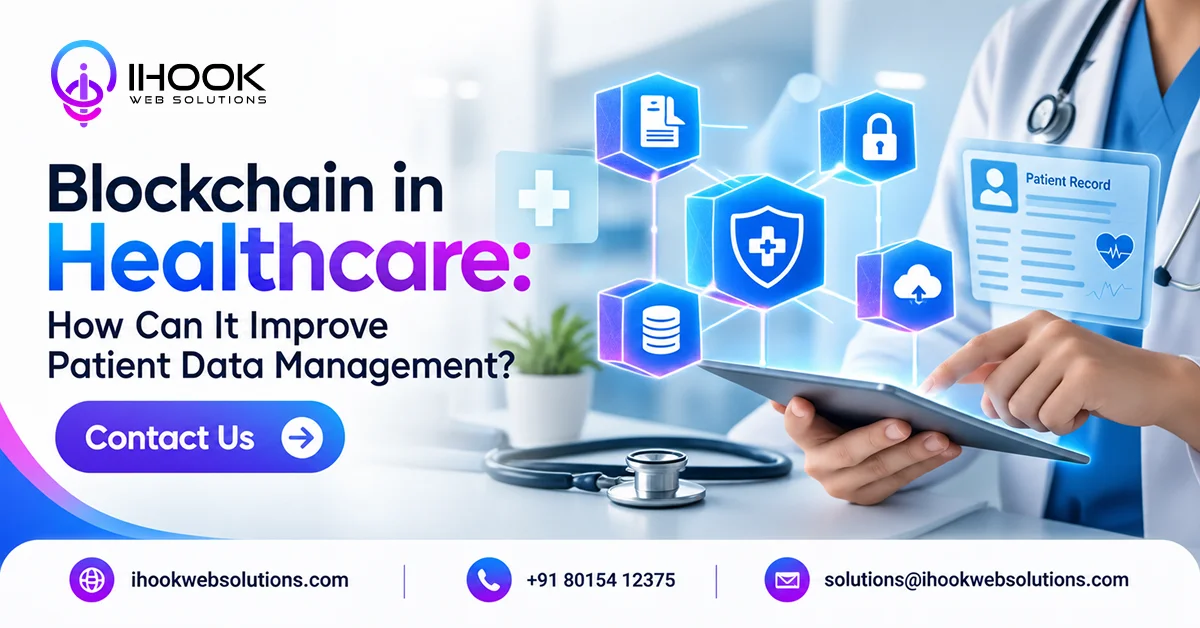
Healthcare organizations handle huge amounts of sensitive information every day. Patient records, laboratory reports, prescriptions, medical images, insurance details, and treatment histories often move between hospitals, clinics, laboratories, pharmacies, and other healthcare providers. Managing this information securely while making it available to the right people at the right time remains a major challenge.
Blockchain technology is gaining attention as a way to improve how healthcare data is managed, shared, and tracked. Rather than replacing existing healthcare systems, blockchain can work alongside them to create a trusted record of data access, permissions, and transactions. Recent research highlights its potential for improving EHR security, interoperability, auditability, and patient control.
Why Patient Data Management Needs a Better Approach
Traditional healthcare data is often stored across different systems. A patient may have information in a hospital EHR, a diagnostic laboratory system, an insurance platform, and a specialist's database.
When these systems do not communicate effectively, healthcare professionals may struggle to obtain complete and updated information. Data fragmentation can also make consent tracking, access monitoring, and secure information sharing more complicated.
Blockchain introduces a shared and tamper-evident record that can help participating organizations track important data activities. Instead of relying entirely on one central database, authorized participants can verify records and transactions through a permissioned network.
How Blockchain Can Improve Patient Data Management
1. Stronger Data Integrity
Healthcare records need to remain accurate and trustworthy. Blockchain creates records that are difficult to alter without leaving a trace. This can provide an additional layer of confidence when organizations need to verify whether information has been changed or accessed.
For example, a blockchain-based system could record when a patient's medical information was created, updated, or accessed. The actual medical file does not necessarily need to be stored directly on the blockchain. Recent clinical-data research notes that many proposed systems keep sensitive medical content off-chain while using blockchain for pointers, consent status, and access events.
2. Easier Data Sharing Between Healthcare Providers
Patients often receive care from multiple providers. Securely exchanging information between these organizations can improve continuity of care.
Blockchain can support controlled data sharing by creating a trusted layer between different healthcare systems. When combined with interoperability standards such as HL7 FHIR, blockchain-based architectures can help organizations exchange information while maintaining clear records of access and authorization.
3. Better Patient Control and Consent Management
Patients increasingly expect greater visibility into how their health information is used.
Blockchain can support consent management by recording permissions and access events in a transparent and auditable way. A patient could potentially authorize a healthcare provider, researcher, insurer, or other approved organization to access specific information according to defined permissions.
Current research is also exploring dynamic and revocable consent models, allowing permissions to be managed more flexibly rather than treating consent as a one-time decision.
4. Improved Security and Audit Trails
Healthcare organizations need to know who accessed sensitive information and when that access occurred. Blockchain can provide a tamper-evident audit trail that makes these activities easier to monitor.
This can be particularly useful for organizations managing multiple systems and users. Instead of depending only on isolated logs, a blockchain layer can provide a consistent record of important data-related events.
5. Supporting Connected Healthcare
Healthcare is becoming increasingly connected through wearable devices, remote monitoring tools, IoT devices, and digital health applications.
This creates more sources of patient information. Blockchain can help create a trusted framework for recording and verifying data generated across connected healthcare environments.
Research published in 2026 is increasingly examining blockchain alongside IoT and AI, particularly for healthcare security, interoperability, and privacy-preserving data exchange.
Current Blockchain Healthcare Trends in 2026
The healthcare blockchain market is moving beyond the simple idea of storing medical records on a distributed ledger. Current research and development are increasingly focused on interoperability, permissioned networks, consent management, AI integration, IoT data, and privacy-preserving data exchange.
Another important trend is the use of permissioned blockchain networks. Healthcare organizations generally require controlled access because patient information is highly sensitive. Recent research also emphasizes that blockchain healthcare projects still need to address scalability, regulatory requirements, legacy-system integration, data standards, and organizational readiness.
This means successful healthcare blockchain solutions are increasingly being designed around real operational requirements rather than blockchain technology alone.
The Future of Patient Data Management
Blockchain has the potential to make healthcare data management more connected, transparent, and patient-focused. It can support secure information exchange, improve auditability, strengthen consent management, and help different healthcare organizations work with trusted data.
At the same time, blockchain should be implemented carefully. Healthcare systems must consider privacy regulations, interoperability standards, performance, identity management, and existing workflows. Current evidence is promising, but many blockchain-based EHR solutions are still at the prototype or pilot stage rather than being widely deployed at production scale.
The opportunity is therefore not simply about putting healthcare records on blockchain. It is about creating a smarter data environment where patients, healthcare professionals, and authorized organizations can securely access and exchange trusted information.
Conclusion
Blockchain can become an important technology for the next generation of healthcare data management. From secure EHR sharing and consent management to audit trails, interoperability, and connected healthcare, its applications are expanding as healthcare organizations look for better ways to manage sensitive information.
IHook Web Solutions provides blockchain development services to help businesses explore and build customized blockchain solutions around their specific operational requirements. From secure blockchain architecture and healthcare applications to integrations and scalable digital solutions, IHook Web Solutions focuses on creating practical technology that can support modern business needs.
FAQ
1. How can blockchain improve patient data management?
Blockchain can improve data integrity, secure information sharing, consent management, and access tracking.
2. Can blockchain secure electronic health records (EHRs)?
Yes. Blockchain can provide tamper-evident records and secure access tracking, while sensitive health data can remain in secure off-chain storage.
3. How does blockchain help patients control their health data?
Blockchain can support permission-based access, allowing patients to manage who can access specific health information.
4. Is blockchain suitable for healthcare data sharing?
Yes. With proper blockchain development, healthcare providers can create controlled and transparent data-sharing systems that integrate with existing platforms.
5. What role does blockchain development play in healthcare?
Blockchain development helps create customized healthcare solutions for secure data management, EHR integration, consent management, and audit trails.